The average person uses 50 – 75 gallons of water every day. Becoming waste conscious you can reduce your usage. Saving water saves money and also helps protect our most precious resource.
These are some practical water conservation tips:
- Wash only full loads in your washing machine and dishwasher.
- Do not run water continuously when washing dishes by hand.
- Attach low-flow faucet aerators to faucets.
- Take short showers instead of baths. A full bath requires approximately 36 gallons of water. A five minute shower using a low-flow restrictor will use 15 – 25 gallons.
- Install low-flow shower heads and toilets. Low flow toilets typically use 1/2 the water of a standard toilet.
- Don’t leave the water running while brushing your teeth and/or shaving.
- Check for leaking faucets and toilets and repair them. A leaking tap, dripping once per second, wastes six gallons of water a day. A leaking toilet can waste up to 5,000 gallons per day.
- Use a nozzle on your hose that will stop the water flow when appropriate.
- Use a broom, not a hose, to clean driveways and sidewalks.
- Store drinking water in the refrigerator, rather than allowing the tap to run for a cold glass of water.
OGRUD works hard to insure that the water we bring to your home is the safest, purest available. That is why we are constantly on the alert for any situation that would degrade that purity. Our cross-connection prevention program is one way that our staff ensures that the water you and your family drink is always the best. We believe, however, that every water customer should know about cross-connections. A cross-connection is any pipe, valve, fixture, etc. in a drinking water plumbing system that may allow the drinking water withing the system to become contaminated or questionable in quality. Even a lawn sprinkler system can be a potential source for contamination. Cross-connections can be eliminated or protected by an air gap or mechanical backflow prevention. Please contact our office for additional information.
Clean, safe drinking water. It is something we take for granted, but every home may have potential hazards which threaten to contaminate our drinking water. Ensuring our water is safe is everyone’s responsibility.
THE PROBLEM
Cross Connections – What is a cross connection? A cross connection is a direct link between a household water line and a contaminated source such as a garden hose, toilet tank or laundry tub. The most common contaminants, such as pesticides, sewage and detergents, can enter your drinking water system through cross connections in home water lines.
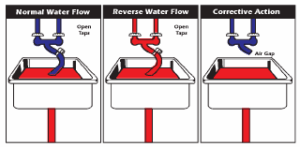
Back Siphonage —Most household cross connections are created by hoses. Under certain conditions, the flow in household water lines can reverse and siphon contaminants into the water supply. For example, using a garden hose to spray pesticides or fertilizers is normally harmless, but if the city’s water supply is interrupted while you are spraying, you may have a problem. If watermain pressure is reduced due to a watermain break or nearby fire fighting, a back siphonage effect is created. This can draw water from your garden hose into your home water supply. So if you have pesticide or fertilizer sprayer attached to your garden hose, the chemicals can contaminate your water supply.
Back pressure —Your drinking water can also be contaminated by an effect called back pressure. Back pressure results when your water supply is connected to a system under high pressure such
THE SOLUTIONS
You can easily prevent back siphonage by installing inexpensive safety devices or taking a few simple precautions.
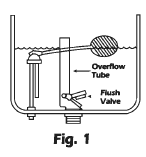
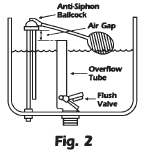
Solution 1 – Anti-siphon Ballcocks – For example, toilet tanks contain a ballcock device which allows water into the tank after flushing. Older style ballcocks do not have an anti-siphon feature and can allow water from the toilet tank to backflow into your drinking water line. (fig. 1) A simple anti-siphon ballcock (fig. 2) installed with a 25mm (1”) air gap above the overflow tube will prevent contaminated tank water from entering your water supply.
Solution 2 – Hose Connection Vacuum Breakers – You can also prevent back siphonage by using an inexpensive, easy-to-install hose connection vacuum breaker. This one-way valve allows water to flow from the tap, but not back in. (Drainable vacuum breakers should be installed on all taps which could freeze.)

Solution 3 – Air Gaps – Leave a gap of at least one inch or two times the pipe diameter (whichever is greater) between the end of a hose and a source of contamination. This eliminates a link between the two. Never leave a hose where it can suck contaminants back into the drinking water supply, such as in a swimming pool, bathtub, sink or fish tank.
WHEN TO CALL THE EXPERTS
Hot water boilers for heating homes, underground lawn sprinkler systems, and automobile pressure washers form cross connections which need proper control. Due to the complexity of these systems, a qualified plumber who is a certified Cross Connection Control specialist should be called for advice and assistance.
Safe Drinking Water is Everybody’s Responsibility
Federal and provincial governments are responsible for setting high standards for water quality. Old Gainesboro Road Utility District is responsible for producing and supplying drinking water which meets or exceeds these standards. Homeowners are responsible for ensuring that drinking water does not become contaminated as a result of a cross connection. Remember, you are not only protecting your own water supply, but your neighbors’ as well.
Swimming Pools
Underground Sprinklers for lawns
Automatic Water for livestock tanks
All of the above can be extremely hazardous.
For more information, contact our office.
Plumbing TipsLeaks are often the culprit for unexplained increased consumption, and toilet leaks are the most common. A toilet can waste thousands of gallons of water in a single billing period. Repairing a toilet leak is usually easy and relatively inexpensive to repair. To check for a leak, remove the top of the tank behind the bowl and put 3-4 drops of food coloring in the tank water. Don’t flush the toilet for an hour or more if possible. Check the water in the toilet bowl, and if the bowl water has been colored with the food coloring, then you have a leak. This type of leak is usually easy to repair by replacing the flapper assembly. if this does not work, consult a plumber. Another leak that is common is a “leaky” faucet whether it is inside your home or at an outside faucet. In order to determine if you have a water leak, read your water meter. Write the reading down and go back and re-read meter approximately 15-20 minutes later and see if any of the numbers on the meter have moved. There is also a leak indicator on most meters which is located in the center of the meters. If leak indicator is moving and no water is being used, there is a leak somewhere. If there is a cut-off valve at the house, cut water off at cut-off and go back to see if meter is still moving. If so, the leak is in your water line. If not, the leak is probably somewhere in your house. Water costs money…don’t waste it! Water per quarter at 60 psi water pressure
Installing a Water Pressure Reducing ValveBecause of Old Gainesboro Road Utility District’s geographical area, water main pressures can range from 20 PSI to 200 PSI. If pressure is checked by plumber and found to be above sixty pounds (60), COUD recommends that pressure regulators be installed on the Customer’s side of meter in order to protect service lines and appliances. Pressure regulators protects household appliances and increases water conservation. Any water pressure in excess of 60 pounds at the meter should be regulated by the installation of a pressure regulator. Most customers need to install a pressure regulator in order to avoid excess pressure on the service line and plumbing connections. We recommend that these regulators be installed on the customer’s side of the meter as indicated on the diagram below. This is a voluntary installation and the cost is the customer’s and/or owner’s expense. These regulators may be purchased wherever plumbing supplies are sold. If you have any questions on this, your plumber can check your pressure before your service line is connected. For more information, contact our office. |